xsection.CompositeSection#
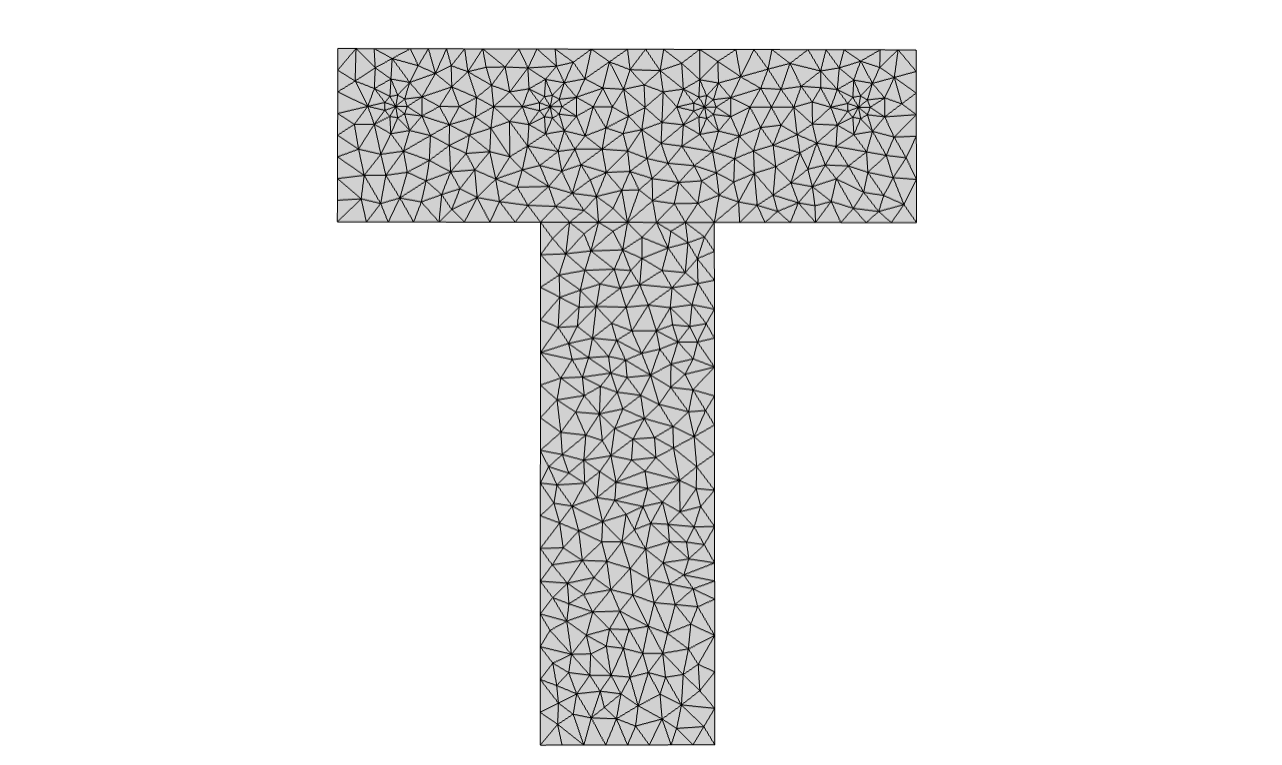
A composite T-section with steel reinforcement.#
- class xsection.CompositeSection(patches, materials=None, poisson=None, holes=None, measure_e=None, **kwds)#
A non-homogeneous cross-section composed from multiple sections.
Parameters#
- patches: list[Section]
A list of sections to combine into a composite section.
- materials: dict[str, Material], optional
Mapping of material names to material properties. If provided, materials will be assigned to patches based on their “group” attribute.
- __init__(patches, materials=None, poisson=None, holes=None, measure_e=None, **kwds)#
Methods
__init__(patches[, materials, poisson, ...])add_patch(patch)add_patches(patch)create_fibers([group, warp_type, center, ...])Create fibers for a finite element simulation.
exterior()interior()linspace(start, stop, num[, endpoint, center])Create
numcopies of this section with centroids linearly aranged fromstarttostop.rotate([angle, principal])summary([shear, format])torsion_warping()translate(dr)
Attributes
|
|
|
|
|
Example#
import veux
from xsection import CompositeSection
from xsection.library import Rectangle, Circle
from xara.units import iks

d   = 18*iks.inch
b   = 20*iks.inch
t   =  6*iks.inch
cv  =  2*iks.inch
bar = Circle(0.4, z=2, mesh_scale=1, divisions=10)

c = CompositeSection([
      Rectangle(t,d),
      Rectangle(b,t).translate([0, -d/2-t/2]),
      *bar.linspace([-(b/2-cv), -d/2-t/1.5], [b/2-cv, -d/2-t/1.5], 4, z=2)
   ])

m = c.model
artist = veux.create_artist(c.model)
artist.draw_surfaces()
artist.draw_outlines()
veux.serve(artist)
units = CreateUnits();

xs = py.importlib.import_module('xsection');
xl = py.importlib.import_module('xsection.library');

d     = 18*xs.units.inch;
b     = 20*xs.units.inch;
t     =  6*xs.units.inch;
cover =  2*xs.units.inch;

flange = xl.Rectangle(t, d);
web    = xl.Rectangle(b, t).translate({0, -d/2-t/2});

section = xs.CompositeSection({flange, web});

% Combine into one shape
section = xs.CompositeSection({web, flange});

%
% Add reinforcement
%

% Create a shape to replicate. The parameter z=2 will ensure
% this material takes priority over the concrete of the rectangular flange
bar = xs.library.Circle(0.4, z=2, mesh_scale=1, divisions=int32(10));

ri  = {-(b/2-cover), -d/2-t/1.5};
rj  = {  b/2-cover , -d/2-t/1.5};
top_bars = bar.linspace(ri, rj, int32(4));

section.add_patches(top_bars);

section = section.translate(section.centroid);

%
% Visualization
%
artist = veux.create_artist(section.model);
artist.draw_outlines();
artist.draw_surfaces(); %field=section.torsion_warping()
artist.save("tee.glb");
% veux.serve(artist);
surfaceMeshShow(readSurfaceMesh("tee.glb"));